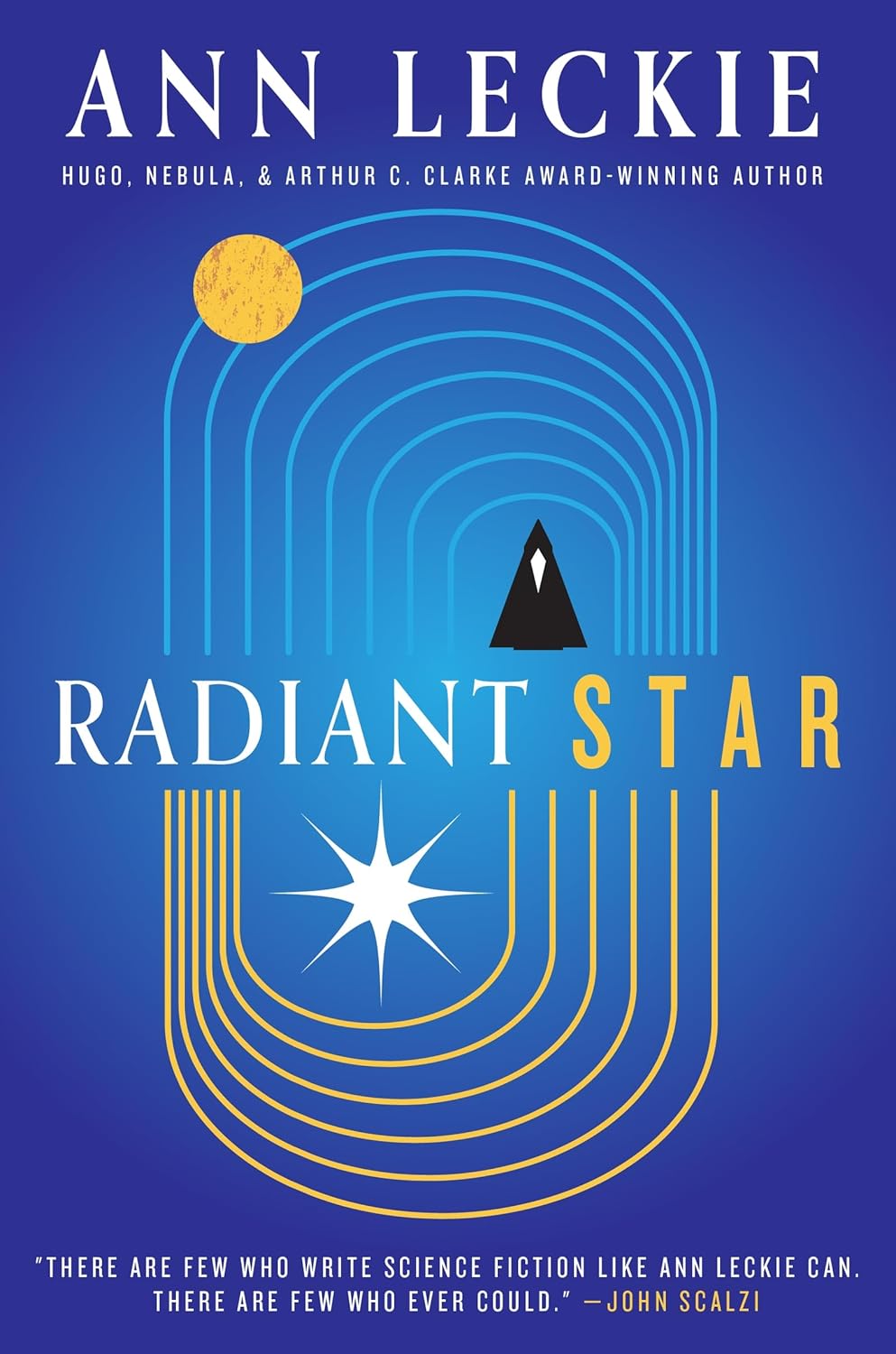
Ann Leckie returns to the world of the Imperial Radch in this standalone.
The Temporal Location of the Radiant Star has always been a source of both conflict and hope for the people of Ooioiaa. However, the imperial Radch see it only as an inconvenience, an antiquated religious site soon to be absorbed into their own, superior culture. But local politics is complicated, and the Radch have made one last concession: One last man will be allowed to join the mummified bodies in the temporal location to become a "living saint".
But this one decision will ripple out to affect every part of the city. Amidst a slowly worsening food shortage, riots, and a communication blackout from the rest of the Radch Empire, a religious savant will entertain visions of his own sainthood, a socialite will discover zer comfortable life upended, and a young man sold into servitude …
Ann Leckie returns to the world of the Imperial Radch in this standalone.
The Temporal Location of the Radiant Star has always been a source of both conflict and hope for the people of Ooioiaa. However, the imperial Radch see it only as an inconvenience, an antiquated religious site soon to be absorbed into their own, superior culture. But local politics is complicated, and the Radch have made one last concession: One last man will be allowed to join the mummified bodies in the temporal location to become a "living saint".
But this one decision will ripple out to affect every part of the city. Amidst a slowly worsening food shortage, riots, and a communication blackout from the rest of the Radch Empire, a religious savant will entertain visions of his own sainthood, a socialite will discover zer comfortable life upended, and a young man sold into servitude will find unlikely escape.
A chance for the author to channel Elliot or a Brontë sister for a society drama for an ice planet. I was endeared by the use of the narrator, and the whole setup of the book. The worldbuilding was fun and interesting, and I liked just being there as I read it. I must admit though, it wasn't all that gripping, I only really felt invested in Jonr's storyline, and if you want a strong narrative drive, you may be disappointed. But I'd give it a shot.
Radiant Star feels most analogous to Provenance—a standalone novel in the Radch universe, with new characters and a new culture. Unfortunately, I just don't think this book holds together in the same way Provenance does: it doesn't have as strong a thematic through line; the climax of the book is weaker; largely, I just wasn't as intrigued by the characters.
There's plenty of intriguing pieces here like local religious politics and practices, food shortages and uncertainty, friction with Radchai culture, a little bit of gender spice, and a slightly unhinged Justice. Sadly, all of it is a bit too disconnected such that doesn't cohere into a satisfying whole.
I greatly fear that if I spent the next paragraphs detailing the operations of Ooioiaa's water treatment and reclamation facility (or, more accurately, facilities—there were of course three separate systems, one for each precinct), you would find it tedious. …
Radiant Star feels most analogous to Provenance—a standalone novel in the Radch universe, with new characters and a new culture. Unfortunately, I just don't think this book holds together in the same way Provenance does: it doesn't have as strong a thematic through line; the climax of the book is weaker; largely, I just wasn't as intrigued by the characters.
There's plenty of intriguing pieces here like local religious politics and practices, food shortages and uncertainty, friction with Radchai culture, a little bit of gender spice, and a slightly unhinged Justice. Sadly, all of it is a bit too disconnected such that doesn't cohere into a satisfying whole.
I greatly fear that if I spent the next paragraphs detailing the operations of Ooioiaa's water treatment and reclamation facility (or, more accurately, facilities—there were of course three separate systems, one for each precinct), you would find it tedious. And even if you, specifically, were to say to me, "But no! I am fascinated by the water treatment systems and would in fact appreciate the information," I would strongly suspect that you were something of an outlier.
The tone of this book is set by a wry, omniscient narrator (historian?) who takes their time to poke fun and highlight hypocritical hierarchs and the naïve rich. It's such a personal tone, that I was honestly a little surprised that we don't really learn anything about them.
Ann Leckie is still an author on my "I will read everything they write" list, but that also means that my expectations for them are really high. I think this book is fine and I enjoyed it for what it was, but it's not one that resonated or will stick with me either.