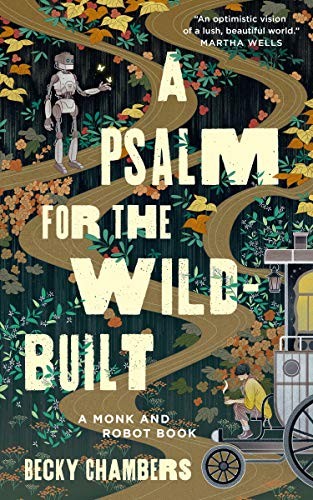
It's been centuries since the robots of Panga gained self-awareness and laid down their tools; centuries since they wandered, en masse, into the wilderness, never to be seen again; centuries since they faded into myth and urban legend.
One day, the life of a tea monk is upended by the arrival of a robot, there to honor the old promise of checking in. The robot cannot go back until the question of "what do people need?" is answered.
But the answer to that question depends on who you ask, and how.
They're going to need to ask it a lot.
Becky Chambers's new series asks: in a world where people have what they want, does having more matter?
Really enjoyed this little book and it's second half. These two novellas felt far more connected to me than a book and it's sequel, and it's odd to me that they're bound and sold as two different books. Priced as two books, as well. Recommended read, though I wish they'd sell the two books bound together for something closer to $15-20
This is exactly what I needed to read at this point in my life. It's so beautiful, and I cried my way through the entire second half. Perhaps it isn't anything groundbreaking, but it has the same "vibes" as a Studio Ghibli film or the video game, Celeste. It's no wonder that this book is so loved.
I'm still digesting this one, but I massively enjoyed reading it. The characterization and worldbuilding are top-notch and done with an exceedingly deft hand.
Kirjan maailmassa ihmiset elävät vehreissä kestävän teknologian kaupungeissa ja puolet planeetasta (tai siis kuusta) on rauhoitettu ihmiskunnalta. Ihmiskunnan muinoin rakentamat ja sitten omille teilleen lähteneet robotit ovat jo melkein unohdettua historiaa. Päähenkilö, kiertävänä "teemunkkina" toimiva Dex, lähtee etsimään merkityksen tunnetta ja törmää robottiin, joka on lähtenyt tutustumaan ihmisten yhteiskuntaan.
Eli siis jonkinlaista tekno-optimistista ja utopistista skifiä on tämä lyhytromaani. Mulle melko uutta "solarpunk"-termiä on myös käytetty teosta kuvaamaan. Ihan kivasti kirjoitettu ja sympaattinen tarina elämän merkityksen etsimisestä, jotenkin liiankin kiva ja mukava. Ehkä kaipaan skifiltäni enemmän konfliktia ja säröä.
Sweet, lovely, cozy fantasy but not without emotional tension
5 stars
What a joy this book was! It's a fairly light adventure, but with an emotional journey, some relatable characters, and a setting that feels like a relatively positive future with some unspecified dark times in its past.
As other reviewers have already said: it is a truly gentle, hopeful, beautiful story about connection and self discovery and communication.
It's got a post capitalist, solarpunk vibe of a world I'd love to inhabit, an appreciation for little pleasures and little deals, loveable characters, and it's also insightful and wise.
Plus the main character rides a bicycle as their main form of transportation!
I now want to leave it all and become a wandering tea monk with a bike.
That's how perfect this book is.
Loved it.
Solarpunk tale of self-discovery and grappling with one's history
5 stars
A compelling yet soothing tale about a non-binary monk having a midlife crisis.
Topics: finding purpose in life, wilderness, the nature of consciousness, and more.
No violence, no struggle apart from that of a person against the pressures of exertion and survival outside of human civilization, and yet it is a page-turner.
It gets the "solarpunk" label because the setting is a human society which fits the bill: non-capitalist, low-impact technology. Main transport method: "ox-bikes," apparently the author's neologism to refer to electronically assisted bicycles that pull carts around. Personal computers are computers that last a person's entire life. Half of the available land is set aside for wilderness. Etc.
100% recommend. It would probably be a good introduction to science fiction for someone who's not familiar with the genre as it exists in the 21st century.
The prose is powerful. The attention to detail, opens up our imaginations towards the possibilities of a solarpunk world. High tech only when needed. We're not the center of the cosmos.
This is the kind of science fiction that makes me hopeful. Makes me sad as well. Sad that I will not live to see this world, but it could have been different, if history were to take a different course.
I wish the book was longer. I want to become a tea monk. I want to be a robot that stares at stalagmites for 30 years in a row.
There's a sequel, I know. But I wish there were a thousand sequels.
I can see now why this is a genre defining book, not because it has a solarpunk setting, but because, by existing, it is bringing those ideals and feelings into the real world. This book is a much needed respite for anyone feeling restless, tired or adrift. If you are trying to read something but don't have the effort, this is the book you are looking for
I like it sometimes when I don't remember why I wanted to read a book. This was one. It can make it a bit difficult at first. Either the author was being sparse of I was being more dense than usual.
By mid point or so I was all in. And really enjoyed it. a couple tears may have been shed at the end. Wonderful.
I like it sometimes when I don't remember why I wanted to read a book. This was one. It can make it a bit difficult at first. Either the author was being sparse of I was being more dense than usual.
By mid point or so I was all in. And really enjoyed it. a couple tears may have been shed at the end. Wonderful.
If I were able to write fiction, I think this is the kind of fiction I’d like to write. The first book in the Monk & Robot series is gentle and thoughtful, but manages to pick at some anxieties I’ve been having for a long time, about purpose and direction and satisfaction. There’s not much in the way of conflict, but plenty in the way of insight, and it’s short enough that I basically inhaled it.
Even more than the characters, I want to spend more time with the book’s religious system, which is revealed in small details but still largely mysterious by the end of the book. The best fictional religions have a way of concisely showing what’s important in a given world—which I guess real religions do, too, but those are so much more multilayered and convoluted from centuries of revision and interpretation that it takes real …
If I were able to write fiction, I think this is the kind of fiction I’d like to write. The first book in the Monk & Robot series is gentle and thoughtful, but manages to pick at some anxieties I’ve been having for a long time, about purpose and direction and satisfaction. There’s not much in the way of conflict, but plenty in the way of insight, and it’s short enough that I basically inhaled it.
Even more than the characters, I want to spend more time with the book’s religious system, which is revealed in small details but still largely mysterious by the end of the book. The best fictional religions have a way of concisely showing what’s important in a given world—which I guess real religions do, too, but those are so much more multilayered and convoluted from centuries of revision and interpretation that it takes real scholarship to that heart. A religion in a fiction is more concentrated by necessity, but still abstracted enough to have that feeling of mystical importance, a distilled philosophy dressed in metaphor. I’m hoping Chambers delves into it more in the sequel.
My first Becky Chambers book, and I think I finally understand the enthusiasm. Wonderful developing relationship between Dex and Mosscap, lots of nature, and woven throughout the story, and increasing towards the end, the struggle to find meaning in life.
I read this book in one sitting from start to finish on Christmas day with hot tea and a blanket. It is precisely what I needed for some relaxation and escape. The book is about breaking patterns, dealing with boredom, trying new things, failing and grappling with what it means to be human - all told through the story between sibling dex, a tea monk and a funny robot named mosscap.