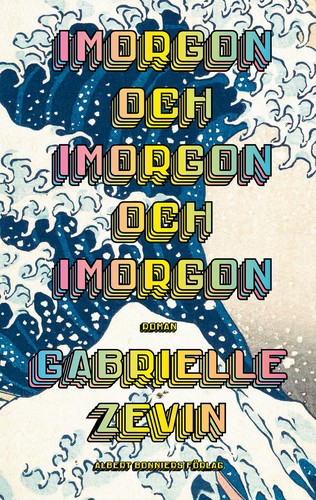
On a bitter-cold day, in the December of his junior year at Harvard, Sam Masur exits a subway car and sees, amid the hordes of people waiting on the platform, Sadie Green. He calls her name. For a moment, she pretends she hasn't heard him, but then, she turns, and a game begins: a legendary collaboration that will launch them to stardom. These friends, intimates since childhood, borrow money, beg favors, and, before even graduating college, they have created their first blockbuster, Ichigo. Overnight, the world is theirs. Not even twenty-five years old, Sam and Sadie are brilliant, successful, and rich, but these qualities won't protect them from their own creative ambitions or the betrayals of their hearts.
Spanning thirty years, from Cambridge, Massachusetts, to Venice Beach, California, and lands in between and far beyond, Gabrielle Zevin's Tomorrow, and Tomorrow, and Tomorrow is a dazzling and intricately imagined novel that …
On a bitter-cold day, in the December of his junior year at Harvard, Sam Masur exits a subway car and sees, amid the hordes of people waiting on the platform, Sadie Green. He calls her name. For a moment, she pretends she hasn't heard him, but then, she turns, and a game begins: a legendary collaboration that will launch them to stardom. These friends, intimates since childhood, borrow money, beg favors, and, before even graduating college, they have created their first blockbuster, Ichigo. Overnight, the world is theirs. Not even twenty-five years old, Sam and Sadie are brilliant, successful, and rich, but these qualities won't protect them from their own creative ambitions or the betrayals of their hearts.
Spanning thirty years, from Cambridge, Massachusetts, to Venice Beach, California, and lands in between and far beyond, Gabrielle Zevin's Tomorrow, and Tomorrow, and Tomorrow is a dazzling and intricately imagined novel that examines the multifarious nature of identity, disability, failure, the redemptive possibilities in play, and above all, our need to connect: to be loved and to love. Yes, it is a love story, but it is not one you have read before.
This book ticks all the boxes for me. It's not only about game development and unrequited / platonic love, it touches on so many things. Honestly couldn't put it down, for good reasons. I kept raving about it for days after finishing it, still think about it sometimes.
Could have done without the communication issues creating unnecessary drama – they made the characters feel really frustrating at times, but those are the flaws they come with, I guess.
I had lots of fun reading Tomorrow, and Tomorrow, and Tomorrow, like a great video game with an engaging story, but there were just a few, crucial moments in the book that left me unsatisfied.
One of it's central theme, about the eternal cycle of life giving us chances to start, fail, and start again, maybe to succeed this time, like someone playing a video game, is fun, and the parallels with players on a stage (hence the quote from Shakespeare as the title) and another layer of reflection on the other theme, the role games can play in our lives.
I liked the characters but sometimes found them inauthentic, acting in ways to make a point or progress the plot, and not necessarily true to who I thought they were. Ultimately, some key moments in the narrative fell flat, jarring me into disbelief, and breaking the spell. …
I had lots of fun reading Tomorrow, and Tomorrow, and Tomorrow, like a great video game with an engaging story, but there were just a few, crucial moments in the book that left me unsatisfied.
One of it's central theme, about the eternal cycle of life giving us chances to start, fail, and start again, maybe to succeed this time, like someone playing a video game, is fun, and the parallels with players on a stage (hence the quote from Shakespeare as the title) and another layer of reflection on the other theme, the role games can play in our lives.
I liked the characters but sometimes found them inauthentic, acting in ways to make a point or progress the plot, and not necessarily true to who I thought they were. Ultimately, some key moments in the narrative fell flat, jarring me into disbelief, and breaking the spell. Still a good read, but missed a bit of it's lofty, and noble, target.
Moving story about love, friendship and death with gamedev as its core
4 stars
Tomorrow, and Tomorrow, and Tomorrow is a really well written novel. Telling a story of 2 childhood friends, Sam and Sadie, reuniting to develop games together, which eventually launches them into a world of fame, business and opportunities but also hatred, dilemmas and rivalry. The character development of these two, their family and their friends is really superb, it's definitely one of the strongest aspects. There are a lot of references to games of the era and gaming culture in general. The only thing that didn't quite meet my expectations is how the actual process of developing games is a bit unrealistic and often just glossed over. While the first game that the duo makes is explained in detail, the next games just mostly happen in the background while the drama takes the stage, which for me feels like a missed opportunity, even though a typical reader might not be …
Tomorrow, and Tomorrow, and Tomorrow is a really well written novel. Telling a story of 2 childhood friends, Sam and Sadie, reuniting to develop games together, which eventually launches them into a world of fame, business and opportunities but also hatred, dilemmas and rivalry. The character development of these two, their family and their friends is really superb, it's definitely one of the strongest aspects. There are a lot of references to games of the era and gaming culture in general. The only thing that didn't quite meet my expectations is how the actual process of developing games is a bit unrealistic and often just glossed over. While the first game that the duo makes is explained in detail, the next games just mostly happen in the background while the drama takes the stage, which for me feels like a missed opportunity, even though a typical reader might not be interested in that aspect.
This is a very good book about relationships of all kinds - familial, romantic, friendly - and the relationships that are harder to define in a single word. Sure, it's also about video game design, narrative structure, being empathetic and kind, and a little love letter to Southern California. It feels like the 1990s, and also timeless. Zevin writes wonderfully about gender, race, age, and all the ups and downs of those definitions across generations.
Very highly recommended, for people who like people.
I loved a lot of this: the deep character building; the reality-details; and the odd topic of early game development. I found at the end, though, that I didn't love it as much as I had while I'd been reading. I grew to dislike Sadie pretty strongly, and felt like her character didn't get as much development as the men, and therefore her choices and behaviors felt abrupt and awful. I'm annoyed that the one woman in the book wasn't treated as carefully and fully as the other two--it really spoiled the whole barrel for me. Having said that, the story and the writing are pretty amazing in how they pull you in and don't let go.
At it's best moments, this book does a really great job of being both about games and evoking the if-then logic of games and game decision points. It also has interesting stuff about game engines (how they shape and constrain creation) and collaboration (the Jobs+Woz dynamic of a salesperson and a designer). It also feels like it was written for late Gen-X or early Millenials - references to Donkey Kong, Oregon Trail, Everquest, etc.
I think I would've liked it more if it were shorter...I liked the first half much better than the second, and some of that is because the latter half ends up pulling in mass shootings and 9-11 in a way that didn't feel like it connected with the core of the novel.
I should add that I listened to this, and I do think reading it would provide even more of that if-then logic. …
At it's best moments, this book does a really great job of being both about games and evoking the if-then logic of games and game decision points. It also has interesting stuff about game engines (how they shape and constrain creation) and collaboration (the Jobs+Woz dynamic of a salesperson and a designer). It also feels like it was written for late Gen-X or early Millenials - references to Donkey Kong, Oregon Trail, Everquest, etc.
I think I would've liked it more if it were shorter...I liked the first half much better than the second, and some of that is because the latter half ends up pulling in mass shootings and 9-11 in a way that didn't feel like it connected with the core of the novel.
I should add that I listened to this, and I do think reading it would provide even more of that if-then logic. It's hard to pay close attention to structure (the book does some interesting stuff with chapter titles and branching logics at one point that doesn't translate as well in an audiobook).